
Growth Mindset vs. Fixed Mindset: How Your Thinking Shapes Your Workday
Why do some people embrace challenges at work while others avoid them? Why do certain teams continuously improve, while others seem stuck despite having similar skills and resources?
A key part of the answer lies in how we think about our own abilities - what psychologists call our mindset.
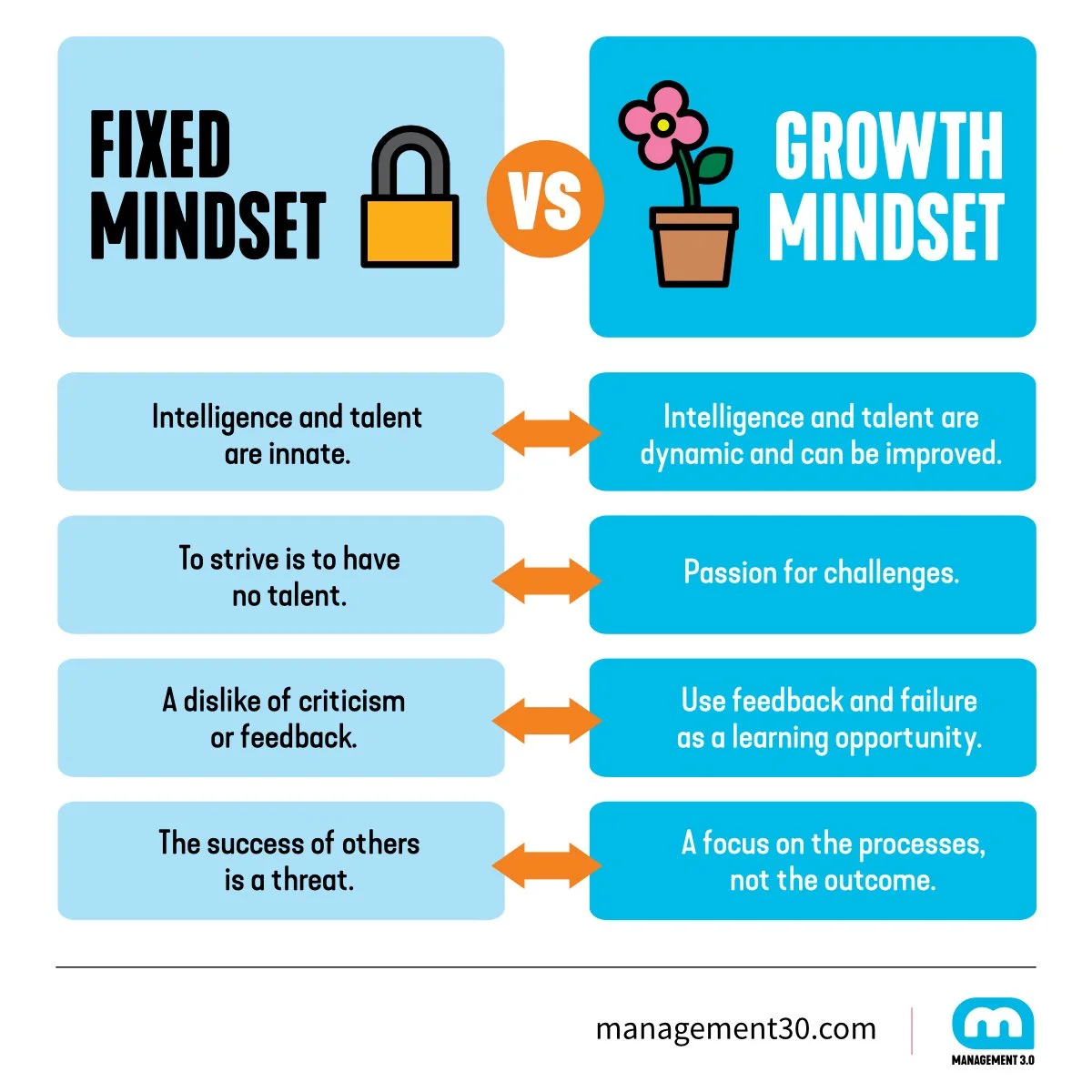
The concept of growth mindset vs. fixed mindset was introduced by Carol Dweck in her influential book Mindset: The New Psychology of Success (Dweck, 2006). According to her research, people tend to fall somewhere along a spectrum between two ways of thinking. Those with a fixed mindset believe that intelligence and talent are largely innate and unchangeable. In contrast, those with a growth mindset believe that abilities can be developed through effort, learning, and persistence.
At first glance, this distinction may seem simple. In reality, it profoundly shapes how we behave every day at work.
How Mindset Shows Up in Daily Work Life
Mindset is not something abstract - it becomes visible in small, everyday moments.
Imagine receiving critical feedback from a colleague. Someone with a fixed mindset may interpret this as a personal failure or a sign that they are “not good enough.” As a result, they may become defensive, disengaged, or even avoid similar situations in the future. Over time, this can lead to stagnation, reduced confidence, and missed opportunities for growth.
By contrast, a person with a growth mindset is more likely to interpret the same feedback as useful information. Instead of asking, “What does this say about me?”, they ask, “What can I learn from this?” This subtle shift creates a completely different trajectory - one that leads to learning, improvement, and resilience.
Research supports this distinction. Studies show that individuals with a growth mindset are more likely to persist through challenges, process mistakes constructively, and ultimately achieve higher levels of performance (Yeager & Dweck, 2012). Neuroscientific findings further suggest that people with a growth mindset show greater brain activity related to error correction and learning, while those with a fixed mindset tend to focus more on performance evaluation.
Why Mindset Matters More Than Ever
In today’s work environment, mindset is not just a personal trait - it is a critical success factor.
Modern organizations, especially those working with Agile approaches, depend on continuous learning, experimentation, and adaptation. Frameworks such as SAFe® or Scrum are built on the assumption that teams will inspect, adapt, and improve regularly. Without a growth mindset, these practices quickly lose their effectiveness.
A retrospective, for example, can either become a blame-driven discussion or a powerful learning mechanism. The difference is rarely the process itself. It is the mindset of the people involved.
This is also reflected in organizational research. Companies that foster a growth mindset culture tend to show higher levels of innovation, collaboration, and employee engagement. In contrast, fixed mindset environments often struggle with risk aversion, silo thinking, and resistance to change.
A Moment for Self-Reflection
Before going further, it is worth pausing and reflecting on your own mindset.
A helpful way to do this is by taking a short self-assessment:
Or try this one: https://blog.mindsetworks.com/what-is-my-mindset
As you go through the questions, consider how you typically respond to challenges, setbacks, and feedback at work. Do you tend to protect your sense of competence, or do you actively seek opportunities to improve?
There is no “perfect” score. The goal is awareness.
Can We Change Our Mindset?
One of the most powerful insights from research is that mindsets themselves are not fixed. Although people may have tendencies toward one way of thinking, these patterns can change over time. This idea is closely linked to the concept of neuroplasticity - the brain’s ability to reorganize itself through learning and experience. In other words, the belief in growth is not just motivational; it is biologically grounded.
However, change does not happen automatically. It requires conscious effort, supportive environments, and often a shift in how we interpret everyday situations. For example, reframing failure as feedback rather than as a personal deficiency can gradually reshape how we respond to challenges. Similarly, focusing on effort, strategy, and learning rather than solely on outcomes helps reinforce a growth-oriented perspective.
A More Nuanced View
While the concept of growth mindset is widely supported, it is sometimes misunderstood or oversimplified.
Researchers such as Yeager (2020) emphasize that simply encouraging people to “have a growth mindset” is not enough. Real change requires alignment with structures, leadership, and resources. If people are expected to learn and grow but are not given time, support, or psychological safety, mindset alone will not drive improvement.
This is where organizational context becomes critical. Leadership plays a key role in modeling learning behavior, normalizing mistakes, and creating environments where growth is truly possible.
Final Thoughts
At its core, mindset shapes how we interpret the world around us. It influences whether we see challenges as threats or opportunities, whether we avoid feedback or seek it out, and whether we remain stuck or continue to evolve. Over time, these small differences compound. They affect not only individual careers, but also team dynamics and organizational success.
As Carol Dweck argues, success is not determined solely by talent, but by how we relate to our own potential. A growth mindset does not mean believing that everything is easy or that effort always leads to success. It means believing that improvement is possible and acting accordingly.
References
Dweck, C. S. (2006). Mindset: The New Psychology of Success.
Yeager, D. S., & Dweck, C. S. (2012). Mindsets that promote resilience.
Martinez, M. A. (2018). Mindset as it relates to implementation of mobile devices for instruction.
Sarshar, M., et al. (2019). T behavior: Psychological implications of thrill-seeking/risk-taking.
